![The 1064/364-Day Bitcoin Cycle [INFOGRAPHIC]](https://www.shortspike.com/static/34/1064-364-cycle__scale_and_crop__500x281.png)
 Markets, data, and the ideas shaping them.
The Right to Repair Is Becoming the Right to Own
From tractors to smartphones, regulators are beginning to ask a surprisingly fundamental question: if you bought it, should the manufacturer still get to decide whether you can fix it?
For most of modern history, owning something came with a fairly obvious implication: you could repair it.
If your car broke down, you could take it to the manufacturer, your local mechanic or — if you knew what you were doing — open the bonnet and fix it yourself. If your washing machine stopped spinning, an appliance repair shop could replace the offending part. If a tractor broke during harvest, the farmer and a mechanic could get it running again.
You might void a warranty. You might make the problem worse. But the decision was largely yours.
Software has complicated that relationship.
Increasingly, the physical object belongs to you while some of the capability required to maintain it remains under the manufacturer's control.
And governments are starting to question whether that still counts as ownership.
A very expensive tractor you can't fully repair
John Deere provides perhaps the clearest example.
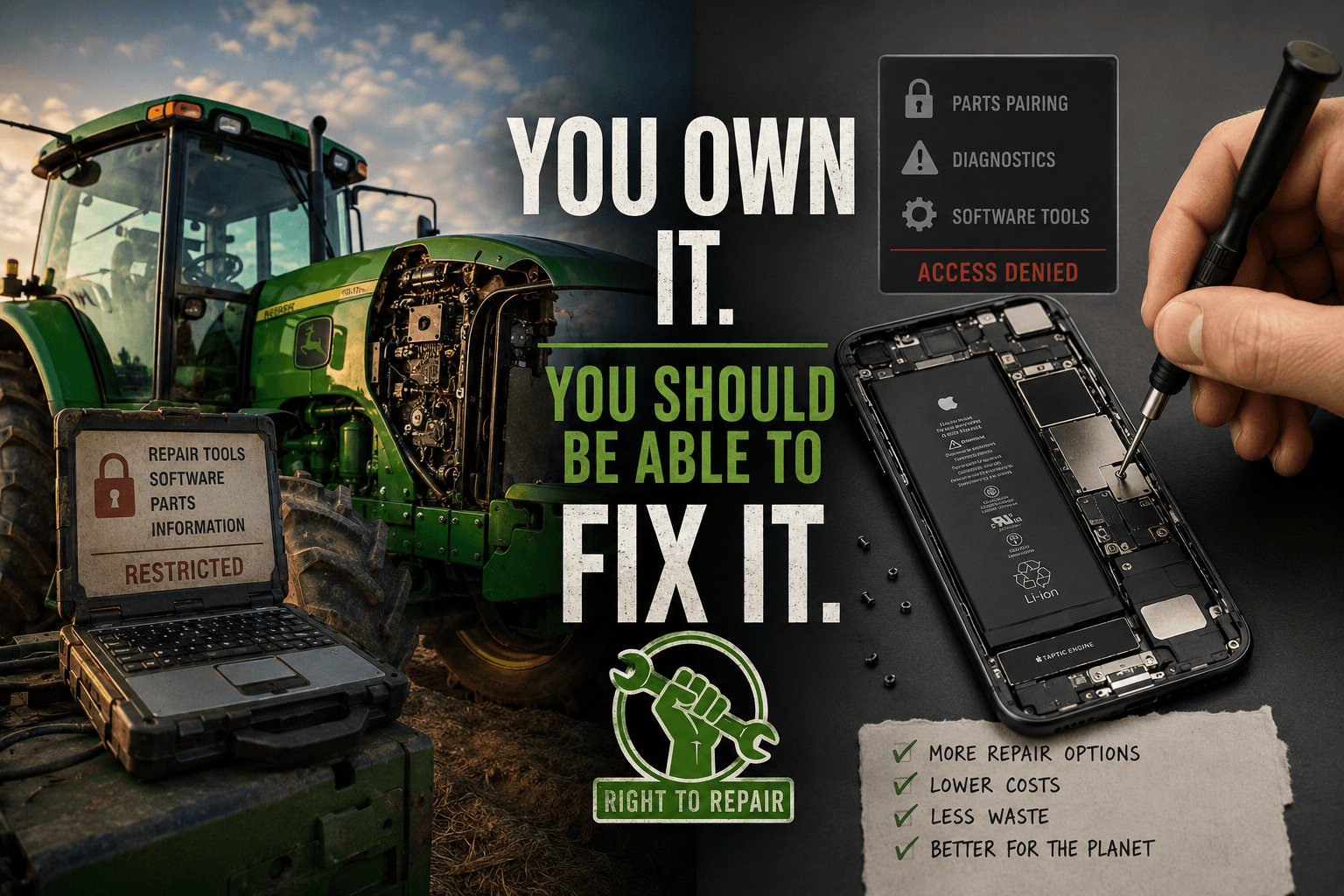
Modern tractors are enormously sophisticated machines. They're packed with computers, sensors, electronic control units and software. That technology makes them more efficient and capable — but it also changes what it means to repair one.
A farmer might be perfectly capable of replacing a broken component, yet still be unable to get the tractor working because the new component needs to be electronically paired with the machine. A fault code may need proprietary software to clear. An emissions-related shutdown may require software intervention before the machine will start again.
The farmer owns the tractor.
John Deere controls some of the tools required to make it work.
That distinction landed Deere in an antitrust battle with the US Federal Trade Commission and several states.
On 8 July 2026, the FTC announced a proposed settlement with Deere & Company that would require Deere, for the next ten years, to make repair resources available to farmers and independent repairers on terms equivalent to those available to authorised Deere dealers.
Those resources include the ability to read and clear electronic fault codes, reprogramme and pair electronic components, restart machines following certain shutdowns, and access technical repair information.
The dispute was also the subject of reporting by the Associated Press.
The significance goes far beyond tractors.
Because the Deere dispute exposes something increasingly common in modern products:
The replacement part is no longer necessarily the whole repair. Software permission can be part of the repair too.
Your phone isn't all that different
A smartphone and a tractor don't have much in common physically.
One fits in your pocket. The other may weigh several tonnes.
But from the perspective of ownership, they are becoming remarkably similar.
Replace a component in a modern electronic device and the job may not end when the screws go back in. Components can be serialised. Software may need to recognise them. Calibration may be required. Diagnostic tools may be restricted.
Apple has already moved some distance on this issue. Its Self Service Repair programme gives technically capable customers access to genuine Apple parts, repair manuals and professional-grade tools for supported devices.
Apple also uses software tools such as Repair Assistant and System Configuration to complete certain post-repair procedures. In other words, even Apple's own self-repair programme illustrates how much modern repair has changed: replacing the physical component may only be one stage of the job.
Europe is now pushing the broader concept of repairability considerably further.
And not just for Apple.
Europe is changing the economics of repair
From 31 July 2026, EU member states are required to apply a new Right to Repair framework intended to make repairing products more attractive than simply replacing them.
The European Commission describes the objective quite simply: extend the lifecycle of products and create a system that favours repair over replacement.
The rules cover household and electronic products including categories such as washing machines, vacuum cleaners, mobile phones and tablets.
Among other things, the new regime means that:
- Consumers can request repair from manufacturers for products that are technically repairable under applicable EU rules, including after the normal legal guarantee period.
- Repairs must be offered within a reasonable time and, unless provided free of charge, at a reasonable price.
- When a consumer chooses repair rather than replacement during the seller's legal liability period, that period is extended by at least another 12 months.
- Manufacturers must provide easily accessible information about their repair services.
- The wider EU framework is intended to improve access to spare parts and make independent repair more practical.
The European Commission recently summarised the idea rather neatly in a post promoting the new Right to Repair regime: less waste, more repairs, lower costs and longer-lasting products.
The legislation also provides for a European online repair platform intended to make it easier for consumers to find repairers and compare repair services. The common European interface is expected to become operational in 2027.
The underlying legislation is Directive (EU) 2024/1799 on common rules promoting the repair of goods.
The direction of travel is clear:
Repair is being treated less as an optional service offered by the manufacturer and more as a characteristic that should follow the product after sale.
Then there are the batteries
Another piece of EU legislation illustrates how far this concept may go.
From 18 February 2027, Article 11 of the EU Batteries Regulation introduces requirements intended to make portable batteries incorporated into products removable and replaceable during the lifetime of those products.
The regulation goes unusually far in defining what "readily removable" means. In general, a portable battery should be removable using commercially available tools without requiring proprietary tools, thermal energy or solvents, although the legislation contains exceptions and product-specific provisions.
You can read the requirement directly in Regulation (EU) 2023/1542 concerning batteries and waste batteries.
This is sometimes simplified into a much more dramatic headline:
"The EU is forcing Apple to bring back removable iPhone batteries."
The reality is more nuanced.
Separate EU ecodesign rules for smartphones and tablets, which began applying on 20 June 2025, already establish requirements around battery durability, spare-parts availability, repair information and access to certain software or firmware required for repairs.
The regulations also contain circumstances in which battery replacement can be handled by professional repairers rather than requiring every device to return to the era of a plastic back cover and a battery that pops out in three seconds.
So we shouldn't necessarily expect the return of the old Nokia-style removable battery.
But that isn't really the interesting part anyway.
The interesting part is that regulators are increasingly treating access to repair as part of the product itself.
The software has become part of the screwdriver
This is where John Deere and Apple unexpectedly meet.
Twenty years ago, right-to-repair was largely a mechanical argument.
Can I open the device?
Can I get the spare part?
Can I obtain the service manual?
Today there's another question:
Will the software let me finish the repair?
You can replace the control unit in a tractor, but if only an authorised dealer can pair it with the machine, your physical ability to install the component is irrelevant.
You can replace a component in a phone, but if proprietary software is required to calibrate, authenticate or fully activate it, possession of the replacement part may only be half of the repair.
The software has effectively become another tool in the toolbox.
Except the manufacturer controls who gets to hold it.
This creates a strange kind of ownership.
You own the machine, but not necessarily the complete process required to maintain the machine.
There are legitimate reasons for some restrictions
Manufacturers aren't completely irrational for wanting control here.
A badly repaired lithium-ion battery can be dangerous.
Incorrect modifications to agricultural machinery can interfere with emissions controls or safety systems.
Smartphones contain sensitive biometric and financial information.
Manufacturers also have legitimate intellectual-property and cybersecurity concerns. Nobody seriously proposing right-to-repair legislation needs to argue that buying an iPhone should automatically entitle you to Apple's source code, or that buying a tractor gives you the right to disable every safety system.
There is a reasonable boundary somewhere.
But "safety" can also become an extremely convenient justification for locking legitimate competitors out of the repair market.
The important distinction is between protecting the integrity of a product and protecting a monopoly on servicing it.
A manufacturer should be allowed to design safety controls.
That doesn't necessarily mean the manufacturer should be the only party allowed to reset them.
Repair is also a competition issue
This is one of the most important aspects of the Deere case.
The right to repair isn't only about whether an enthusiast can buy a screwdriver set and repair something at home.
It is also about whether an independent business can compete with the manufacturer's authorised service network.
The FTC alleged that Deere's restrictions forced many farmers to depend on authorised dealers for repairs, contributing to higher repair costs and delays.
That is particularly significant in agriculture.
If your phone is unavailable for an afternoon, it is annoying.
If a combine harvester is unavailable during the narrow period when a crop needs to be harvested, downtime can have a direct financial cost.
But the competitive principle is identical whether the machine costs $1,000 or $500,000.
If independent repairers cannot access the tools, documentation, software or components required to perform a repair, then the manufacturer can effectively control the aftermarket long after the original sale.
The washing machine matters too
It's easy to turn right-to-repair into a debate about Apple because smartphones attract attention.
But the washing machine may actually be the better example.
Most people don't particularly want to repair a washing machine themselves.
They simply want repairing it to make economic sense.
When a relatively small component fails in an otherwise functional appliance, there are three obvious possibilities:
- Repair it yourself.
- Pay an independent technician to repair it.
- Ask the manufacturer or its authorised service network to repair it.
When none of those options is economical because parts are unavailable, documentation is restricted or the repair has deliberately been made unnecessarily difficult, a fourth option becomes dominant:
Throw the entire machine away and buy another one.
That isn't merely bad for the consumer.
It has environmental consequences too.
A device containing hundreds of components can become waste because one relatively inexpensive component reached the end of its useful life.
This is why European repair legislation increasingly connects consumer rights, competition and environmental policy.
Ownership shouldn't require manufacturer permission
This is ultimately why the right-to-repair debate is becoming much bigger than repair.
It is becoming a debate about ownership itself.
When you purchase a machine outright, what exactly have you purchased?
The physical components?
The right to operate them?
The right to maintain them?
The right to replace a failed component?
The right to choose someone other than the original manufacturer to perform that repair?
For purely mechanical products, we rarely needed legislation to answer these questions. The architecture of the product answered them for us.
Software-controlled products are different.
Manufacturers can now retain technical control long after ownership has legally transferred to the customer.
That creates an unusual imbalance: the customer carries the economic risks of ownership — depreciation, damage, maintenance and eventual replacement — while the manufacturer can continue controlling some of the decisions traditionally associated with ownership.
Right-to-repair laws are beginning to push back against that imbalance.
Not by saying manufacturers must give away their technology.
Not by guaranteeing that every consumer can safely perform every repair.
But by establishing a principle that should probably have been obvious all along:
A manufacturer shouldn't be able to use technology merely to prevent the owner of a product from repairing it, or from choosing someone else to repair it.
A farmer shouldn't need permission from John Deere to make a tractor he owns operational again.
A phone shouldn't become disposable because its battery has reached the end of its useful life.
A washing machine shouldn't end up in landfill because replacing a relatively inexpensive component has been made uneconomical.
The right to repair sounds like a niche consumer issue.
It isn't.
As more of the things around us become computers wrapped in machinery, appliances and vehicles, the question becomes increasingly fundamental.
If you bought it, but the manufacturer can still decide who is allowed to fix it, how much of it do you actually own?
Sources and further reading
- Associated Press — John Deere and the Right to Repair
- US Federal Trade Commission — FTC, States Secure Settlement with Deere & Company, Advancing Farmers' Right to Repair
- Apple — Self Service Repair
- European Commission — Right to Repair: New Consumer Rights for Easy and Attractive Repairs
- European Commission — Right to Repair announcement
- EUR-Lex — Directive (EU) 2024/1799 on Common Rules Promoting the Repair of Goods
- EUR-Lex — Regulation (EU) 2023/1542 concerning batteries and waste batteries
- EUR-Lex — Regulation (EU) 2023/1670 establishing ecodesign requirements for smartphones and tablets
POPULAR ARTICLES
View all