![The 1064/364-Day Bitcoin Cycle [INFOGRAPHIC]](https://www.shortspike.com/static/34/1064-364-cycle__scale_and_crop__500x281.png)
 Markets, data, and the ideas shaping them.
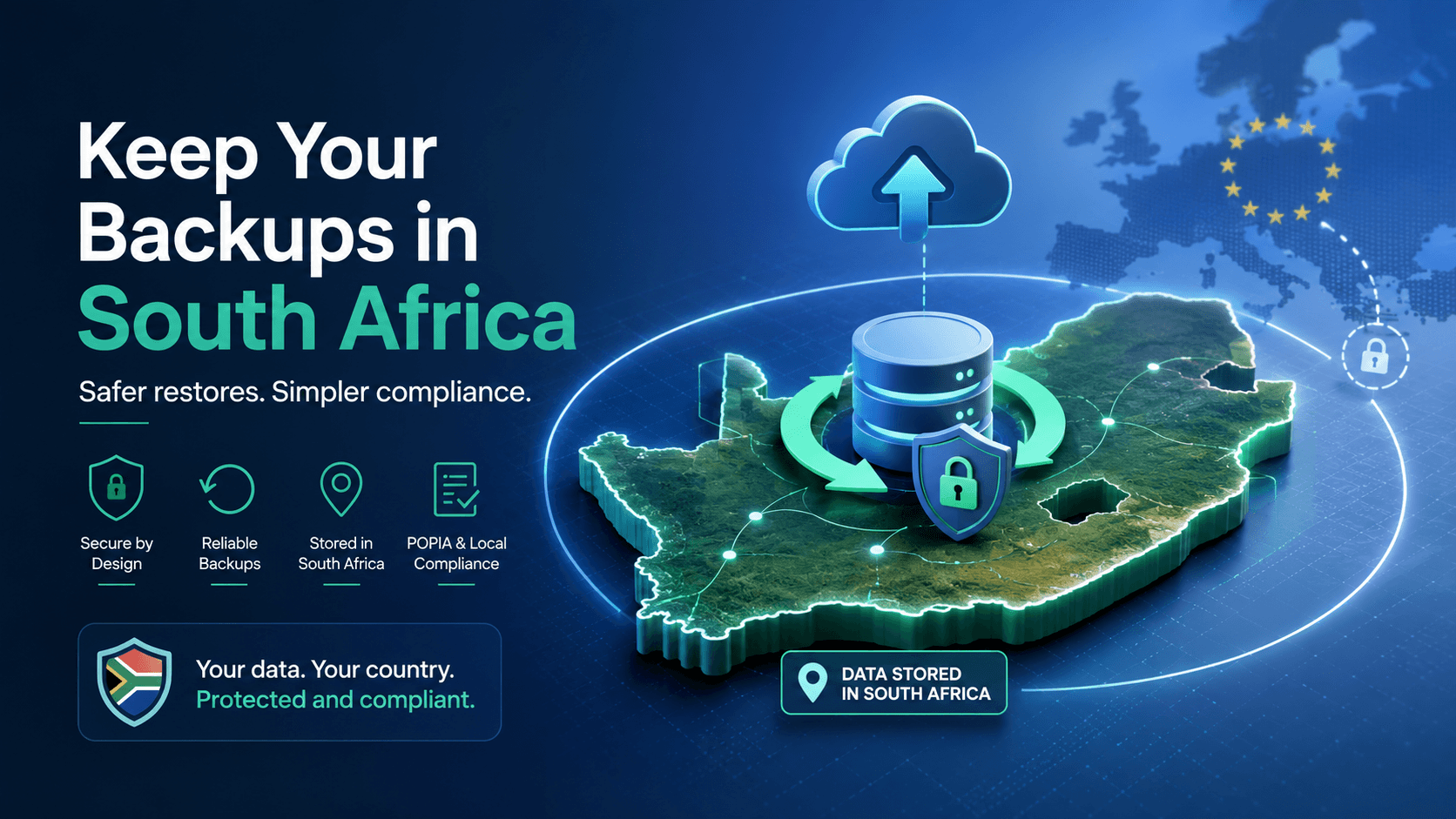
Why South African Businesses Should Keep Backup Data in South Africa
For South African businesses, backup location affects POPIA compliance, cross-border data transfers, restore speed, and operational risk. Here’s why local backup storage matters.
Most companies treat backups as a technical safety net: something you configure once, check occasionally, and hope never to use. That is too narrow.
A backup is not a lesser copy of your data. It is still your data. If it contains customer records, employee files, invoices, medical information, financial records, access logs, support tickets, or database dumps, it may contain personal information. Under South Africa’s Protection of Personal Information Act, “processing” includes storage, retrieval, transmission, erasure, and destruction — which means backups are part of your data-protection footprint, not outside it. Read the POPIA Act .
For South African businesses, that raises a practical question: where are your backups actually stored?
Local backups reduce legal complexity
POPIA does not say that every South African business must store all data only in South Africa. It does, however, regulate transfers of personal information outside the Republic.
Section 72 of POPIA says that a responsible party in South Africa may not transfer personal information to a third party in a foreign country unless one of the permitted conditions applies. These include adequate protection through law, binding corporate rules or binding agreements, consent, contractual necessity, or certain data-subject benefit scenarios.
That matters because a backup to a foreign cloud region is still a transfer. If your production system is in Johannesburg but your nightly database dump goes to Ireland, Frankfurt, London, Singapore, or the United States, you have introduced a cross-border data-flow question. That question may be manageable, but it must be answered deliberately.
Keeping backups in South Africa does not make a company automatically POPIA-compliant. You still need proper security, retention rules, access control, encryption, restore testing, and vendor contracts. But local backup storage can reduce the compliance surface area. There is less ambiguity about where the data sits, which law primarily governs the storage environment, and what must be explained to customers, auditors, regulators, or enterprise procurement teams.
The EU is not just “another data centre”
Many South African teams choose European servers because latency is reasonable, providers are mature, and pricing can be attractive. That can be a valid architecture. But it should not happen by accident.
The GDPR applies to processing in the context of an EU establishment, regardless of whether the processing itself happens in the EU. It can also apply to a non-EU controller or processor where the processing relates to offering goods or services to people in the EU, or monitoring their behaviour in the EU. Read the GDPR regulation .
So the legal point is not simply “EU server equals GDPR.” The more accurate point is this: once your backup architecture touches EU infrastructure, EU customers, EU processors, or EU data subjects, you need to understand whether GDPR obligations are in play.
That can affect your data-processing agreements, subprocessor review, incident response process, transfer mechanism, retention policy, and privacy notice. For many small and mid-sized South African businesses, that is unnecessary complexity for a backup system whose main job is resilience.
Cloud regions must be configured, not assumed
Using a global cloud provider does not automatically mean your data is stored globally. It depends on the region and service configuration.
AWS, for example, has an Africa region in Cape Town, with region code af-south-1. AWS lists Africa
(Cape Town) as a South African geography with three Availability Zones.
View AWS regions
.
AWS also states that customers choose the AWS regions in which their content is stored, and that AWS will not move or replicate customer content outside the chosen regions without the customer’s agreement, except in defined circumstances such as legal compulsion or services initiated by the customer. View AWS data privacy information .
That means the burden is partly technical. If you intend to keep backups in South Africa, your infrastructure must enforce that intention.
For Amazon S3, that means creating buckets in af-south-1, ensuring your SDKs, backup tools,
lifecycle rules, replication rules, and infrastructure-as-code templates are pointed at the correct region.
The S3 endpoint for Africa (Cape Town) is s3.af-south-1.amazonaws.com.
View Amazon S3 endpoints
.
It also means avoiding accidental cross-region replication. AWS S3 supports Cross-Region Replication, which copies objects into buckets in different AWS regions, and Same-Region Replication, which copies objects within the same region. AWS notes that Same-Region Replication can help where compliance rules do not allow data to leave a country. View Amazon S3 replication documentation .
A practical South African backup checklist
For a South African business, a defensible backup policy should answer these questions:
- What data is included in the backup?
- Does it contain personal information, special personal information, customer data, employee data, or confidential business records?
- Which country and cloud region stores the primary backup?
- Are replicas, archives, logs, snapshots, and disaster-recovery copies also local?
- Is the backup encrypted in transit and at rest?
- Who can access the backup environment?
- Are backup credentials separate from production credentials?
- Are backups immutable or protected against ransomware deletion?
- How long are backups retained?
- Has a restore been tested recently?
The most common failure is not that a business has no backups. It is that nobody knows where the backups are, whether they can be restored, or whether the backup design contradicts the company’s own privacy commitments.
Local is simpler, faster, and easier to defend
Local backup storage is not only a legal consideration. It also has operational benefits.
Restores from a South African region can be faster and more predictable for South African workloads. Support discussions are simpler. Procurement reviews are cleaner. Enterprise customers are more comfortable when the answer to “where is our data stored?” is precise and local. Auditors prefer evidence over assumptions.
The best backup strategy is not just “three copies somewhere.” It is a controlled, documented, tested recovery system that aligns with the company’s legal and operational obligations.
For South African businesses, that often means keeping backup data in South Africa by default — and only moving it offshore when there is a clear reason, a documented legal basis, and the right contractual and technical safeguards.
Bottom Line
Backups should be boring. Data residency should not be.
A South African company should be able to say exactly where its backup data is stored, who can access it, how it is protected, and how quickly it can be restored. If the answer is “somewhere in the cloud,” the backup system needs work.
Local-first backup architecture is not about avoiding cloud platforms. It is about configuring them correctly, documenting the decision, and reducing unnecessary legal and operational risk.
This article is general information and should not be treated as legal advice. For specific POPIA, GDPR, or cross-border transfer questions, consult a qualified legal professional.
POPULAR ARTICLES
View all