![The 1064/364-Day Bitcoin Cycle [INFOGRAPHIC]](https://www.shortspike.com/static/34/1064-364-cycle__scale_and_crop__500x281.png)
 Markets, data, and the ideas shaping them.
Carry Trades Explained
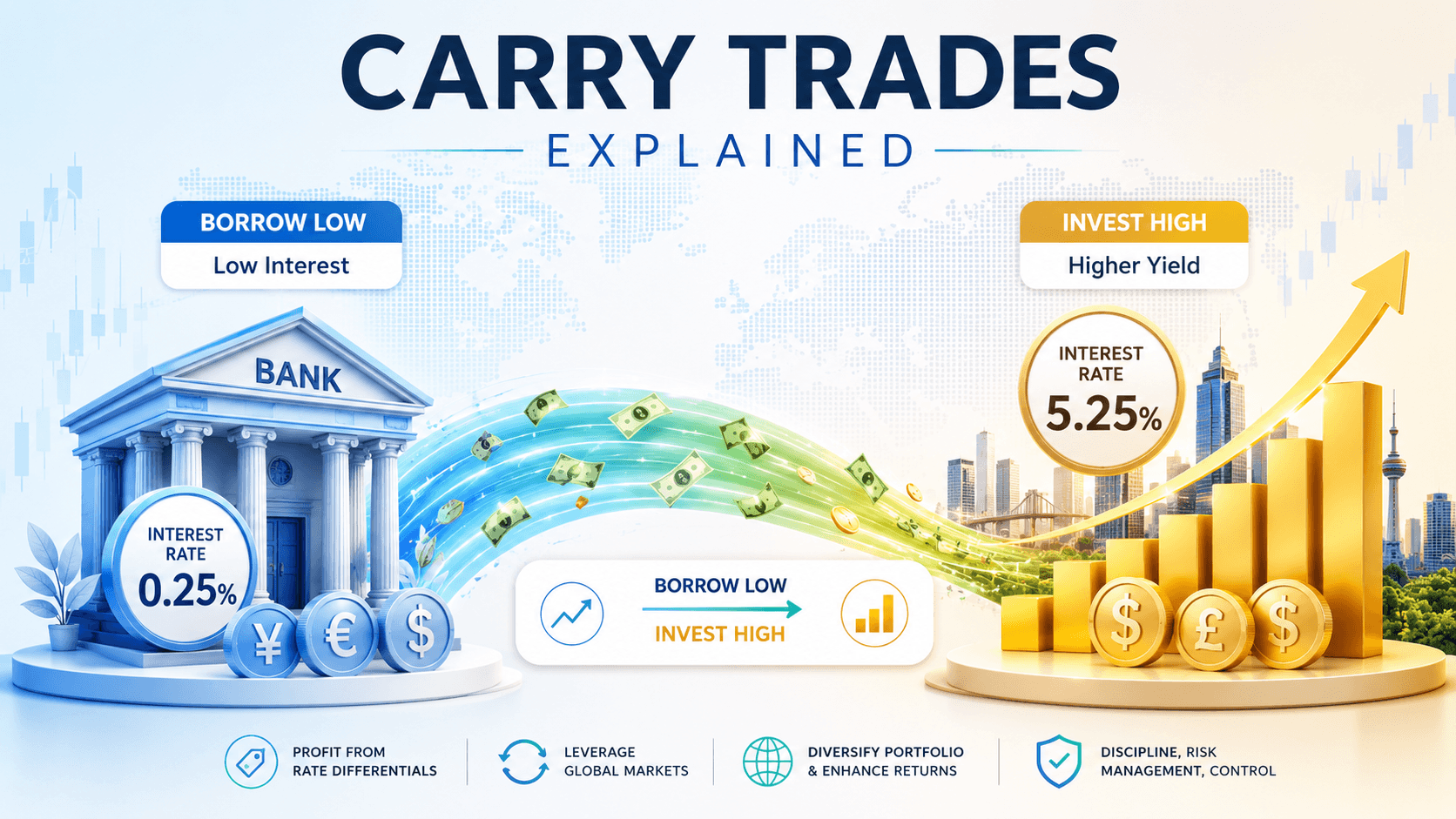
A carry trade aims to profit from interest-rate differences between currencies or assets. The opportunity can be real, but so are the currency, leverage and liquidity risks.
A carry trade is a market strategy built around a simple premise: borrow in a currency with a relatively low interest rate, then invest the proceeds in a currency or asset with a relatively higher expected return.
In its most familiar form, the carry trade takes place in the foreign-exchange market. An investor funds a position in a low-yielding currency, converts it into a higher-yielding currency and earns the difference between the two rates. That difference is known as the interest-rate differential, or simply the carry.
The attraction is obvious: borrow low, invest high. The complication is that the exchange rate can move far more quickly than interest income accumulates.
How a carry trade works
A basic carry trade has three steps:
- Borrow or fund a position in a low-interest-rate currency.
- Convert the funds into a higher-yielding currency.
- Invest in a higher-yielding instrument or hold the higher-yielding currency position.
Consider a simplified illustration. An investor funds a position at an annual cost of 2% and invests in an asset or currency-linked instrument earning 8%.
| Component | Illustrative annual rate |
|---|---|
| Return on the higher-yield investment | 8% |
| Funding cost | -2% |
| Gross carry before costs and currency movements | 6% |
Before dealing costs, tax, hedging and currency movements, the investor has a 6% annual interest-rate advantage. But that is only one part of the return.
Why currency moves can overwhelm the carry
Carry builds gradually. Currency losses can happen very quickly.
In the example above, a 6% gross carry may look attractive. But if the higher-yielding currency falls 10% against the funding currency, the investor could still lose roughly 4% before costs. A sharp currency move can therefore erase months, or even years, of accumulated carry.
| Move in the investment currency | Approximate result before costs |
|---|---|
| Currency strengthens by 5% | About 11% gain |
| Currency is unchanged | About 6% gain |
| Currency weakens by 6% | Roughly break-even |
| Currency weakens by 10% | About 4% loss |
This is why carry trades tend to perform best when markets are calm, volatility is low and investors are willing to take risk. They tend to struggle when investors suddenly seek safety, reduce leverage and sell emerging-market or higher-yielding currencies.
Why carry trades matter for the rand
The rand often features in carry-trade discussions because South Africa has historically offered higher interest rates than several developed markets. That can make rand-denominated cash, bonds and other income-producing assets attractive to global investors searching for yield.
However, the rand is also sensitive to global risk appetite. Foreign investors may buy rand-denominated assets when markets are supportive, but those flows can reverse rapidly when sentiment deteriorates.
Factors that can affect the rand and the appeal of rand carry include:
- South African Reserve Bank policy and inflation expectations
- US interest-rate expectations and US dollar strength
- Local fiscal conditions and sovereign-risk perceptions
- Commodity prices and global growth expectations
- Domestic electricity, logistics and reform developments
- Broad global appetite for emerging-market risk
A high rand yield may be attractive in isolation, but it does not protect an offshore investor from a weakening currency.
Can ordinary retail investors use carry trades?
Yes, but the retail version is usually less straightforward — and more risky — than the textbook explanation suggests.
Professional investors often use borrowing facilities, FX forwards, swaps or options to create carry positions. Retail investors generally have fewer tools, less favourable financing terms and less capacity to absorb sudden losses.
1. Retail FX or CFD carry trades
The closest retail version is to hold a currency pair through a forex or CFD broker where the long currency has a higher effective rate than the short currency. Depending on the broker and direction of the trade, the account may receive or pay a daily financing adjustment, often called a swap, rollover or overnight financing rate.
This is not a simple way to collect interest. Broker financing rates can differ materially from central-bank policy rates, spreads and commissions reduce returns, and leverage can magnify losses. A positive daily swap does not make the underlying currency position low risk.
2. Offshore cash, money-market funds or short-duration bond exposure
A more conservative route is to take unlevered exposure to a foreign currency and hold a cash-equivalent, money-market fund or short-duration bond fund in that currency.
This is not a pure carry trade because the investor is not borrowing cheaply to amplify the interest-rate gap. It is, however, a practical way to earn foreign-currency income while accepting that the rand exchange rate may affect the ultimate return when funds are converted back.
3. Professionally managed global-income or macro funds
Some professionally managed funds use currency, rates and bond-market opportunities as part of a broader global-income or macro strategy. This can reduce the operational burden for an individual investor, although it does not remove market risk and may involve management fees, offshore tax considerations and currency exposure.
What South African retail investors should check first
Before taking offshore or leveraged exposure, South African investors should work through the practical constraints as carefully as the investment case.
- Understand the actual financing rate. Check the broker's stated swap or overnight-financing schedule for the specific instrument. Do not assume it will equal the difference between two headline policy rates.
- Measure the currency risk. Ask how much adverse exchange-rate movement would eliminate the expected carry. That figure is often smaller than investors expect.
- Avoid relying on leverage. Leverage may make a modest carry look meaningful, but it also makes margin calls and forced exits more likely during volatility spikes.
- Check regulation and provider status. Use regulated providers and verify financial-services-provider status through the Financial Sector Conduct Authority's register.
- Follow offshore-investment rules. South African residents must use authorised channels and remain within the exchange-control allowances and requirements that apply to their transfers.
- Consider tax before investing. Interest, trading gains, capital gains and foreign-income treatment can differ based on the facts of the investment and the investor's tax position.
South African offshore-investment considerations
As at July 2026, the South African Reserve Bank's updated rules allow qualifying South African residents aged 18 and over to use a R2 million single discretionary allowance per calendar year for legal purposes abroad, including investment. A separate foreign capital allowance may be available in certain circumstances, subject to applicable requirements.
These rules and administrative requirements can change. Investors should confirm the current process, documentation and tax-compliance requirements with their authorised dealer, bank or appropriately licensed adviser before transferring funds offshore.
Carry trades and market sentiment
Carry trades are closely tied to global market sentiment. When investors are optimistic, they may be more comfortable borrowing cheaply and investing in higher-yielding currencies and assets. This can support currencies such as the rand.
When conditions change, the unwind can be abrupt. A surprise shift in US rate expectations, geopolitical stress, weaker global growth or a market-volatility shock can prompt investors to close similar positions at the same time.
This is known as a carry-trade unwind. It can lead to sharp moves in currencies, bond yields and risk assets as investors repay funding positions and reduce exposure to higher-risk markets.
The bottom line
A carry trade is an attempt to earn the gap between a low funding rate and a higher return elsewhere. It can work when interest-rate differentials are wide, volatility is contained and the investment currency remains stable or strengthens.
But the strategy is not free money. Currency moves, leverage, financing costs and a sudden change in global sentiment can overwhelm the income earned from the carry.
For most retail investors, the more practical question is not “Which carry trade pays the most?” but “Can I understand, fund and survive the currency risk involved?” If the answer is unclear, unlevered offshore exposure or a diversified portfolio is generally easier to manage than a leveraged currency position.
POPULAR ARTICLES
View all