![The 1064/364-Day Bitcoin Cycle [INFOGRAPHIC]](https://www.shortspike.com/static/34/1064-364-cycle__scale_and_crop__500x281.png)
 Markets, data, and the ideas shaping them.
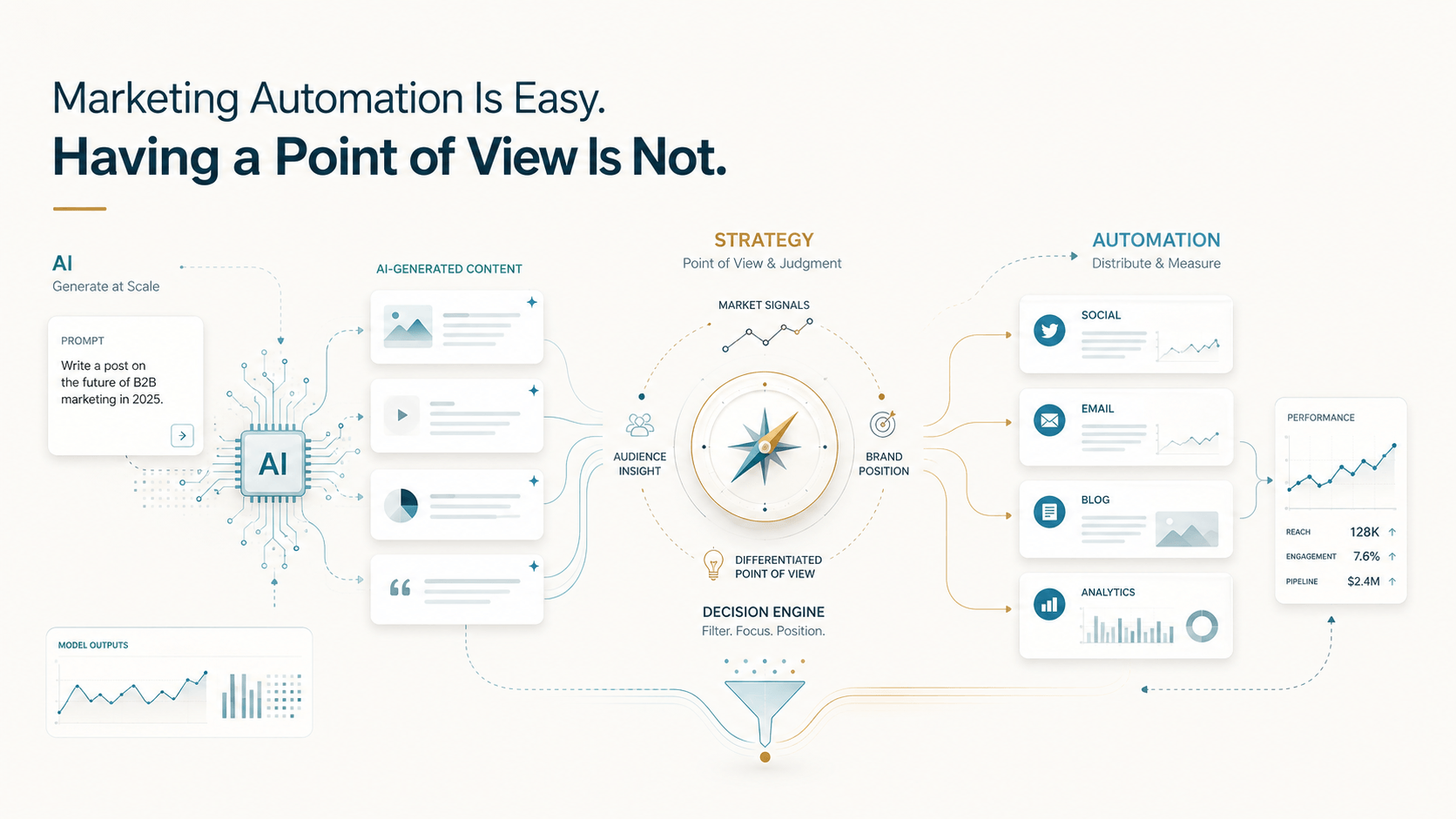
Marketing Automation Is Easy. Having a Point of View Is Not.
Marketing automation has become dramatically easier. AI can draft posts, summarise articles, rewrite announcements, generate campaign ideas and turn one piece of content into ten variations. Automation tools can schedule those posts, publish them across channels and feed the results back into dashboards.
That sounds like the hard part has been solved. It has not.
The hard part of marketing was never only production. It was knowing what to say, who to say it to, and why anyone should care.
The production problem is shrinking
A few years ago, many companies struggled because content production was slow. Writing a LinkedIn post, newsletter, blog article or campaign email took time. Repurposing that material for different platforms took even longer.
AI has changed that. A product update can become a LinkedIn post, a short email, a blog intro, a sales enablement note and a campaign concept in minutes. Automation can then move that content through a publishing workflow.
A good example is the kind of social-posting automation built by Teruza: an article, product update or announcement can be turned into multiple social posts and pushed through a repeatable publishing process. That solves part of the distribution problem.
But it does not solve the strategy problem.
Automation scales the message. It does not create the message.
Automation is powerful when the input is strong. It is dangerous when the input is weak.
If a company has clear positioning, useful proof points, a defined audience and a strong point of view, AI can help turn that into more consistent output. But if the business has vague messaging, generic claims and no obvious differentiation, automation simply publishes that weakness more often.
More content is not the same as better marketing. A calendar full of posts does not mean the market understands you. A stream of AI-generated updates does not mean customers trust you. A campaign workflow does not mean there is a campaign strategy.
The new marketing stack has three layers
The modern marketing stack is not just software. It has three layers.
1. AI creates the raw material
AI can draft, summarise, rewrite and repurpose. It can create first versions quickly and help teams avoid the blank page. This is useful, but it is not strategy.
2. Automation moves the material through the system
Automation can schedule posts, trigger emails, update CRM records, generate reports and connect platforms. This improves consistency and reduces manual work. But it still depends on the quality of the underlying message.
3. Strategy gives the material meaning
Strategy decides the audience, positioning, narrative, offer, proof, timing and commercial objective. It answers the questions automation cannot answer: what should the market believe about us, and why?
AI made content cheaper. That made point of view more valuable.
When content was expensive to produce, simply publishing regularly could create an advantage. That advantage is fading. Almost every company can now publish more often.
The result is a noisier market. Feeds are filled with competent, polished and forgettable content. Most of it sounds correct. Very little of it sounds necessary.
This is where point of view matters. A point of view gives a company an argument, not just an announcement. It turns content from “here is what we do” into “here is how we see the market, and why that matters”.
Companies still need marketing judgment
AI and automation can help companies publish more consistently, but they do not decide what the market should believe about the business. That is still the work of positioning, brand strategy and campaign thinking, the kind of work handled by marketing partners such as Howl.
The best use of AI is not to replace marketing judgment. It is to make good marketing judgment easier to execute.
The mistake is treating automation as the strategy
Many companies will make the same mistake over the next few years. They will build a content machine before they know what the machine should say.
They will automate social posts, newsletters and campaign flows. They will produce more content than before. They may even look more active. But if the message is generic, the output will still be generic.
Automation rewards clarity. It punishes vagueness.
The practical takeaway
Marketing automation is now the easy part. The hard part is having a point of view worth automating.
Before scaling content, companies should be able to answer a few basic questions:
- Who exactly are we trying to reach?
- What do we want them to believe?
- What problem do we understand better than our competitors?
- What proof do we have?
- What should our content make the market do next?
Once those answers are clear, AI and automation become powerful. Without them, they mostly create noise.
The future of marketing is not humans versus machines. It is human judgment amplified by machines.
POPULAR ARTICLES
View all